
THANK YOU FOR SUBSCRIBING
× 
Startup City Weekly Brief
Be first to read the latest tech news, Industry Leader's Insights, and CIO interviews of medium and large enterprises exclusively from Startup City
Startup City: Specials Magazine
LUMO Labs
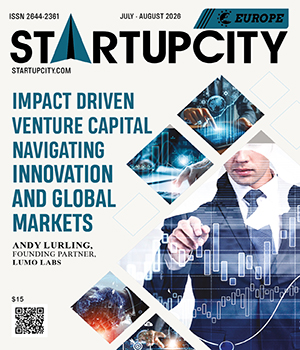
Impact Driven Venture Capital Navigating Innovation And Global Markets
Andy Lurling is the Founding Partner of LUMO Labs, a tech-focused impact VC investing in AI, cryptology, IoT, and AR/VR. He leads fundraising and deal sourcing and backs early-stage startups addressing UN SDGs in health, education, sustainability, and climate. A former PwC professional turned entrepreneur, he co-founded and exited a tech company before launching LUMO Labs with Sven Bakkes. As a founder-turnedinvestor, he brings hands-on experience to support startups through their growth journey. Through this article, Lurling highlights how impactdriven venture capital can strategically connect emerging technologies with business opportunities and societal needs while addressing challenges in scaling, cultural dynamics, and long-term positive impact. Bridging Emerging Technologies, Business And Societal Impact With LUMO, we invest in both societal and environmental impact. In defining our investment thesis, we have looked at challenging megatrends in the world and how technology and ‘common sense’ could help to disrupt these trends. So, I always start thinking from the Audacious goal and then re-engineer and re-cast back to where we are today to define the path, including all technological, commercial, financial, regulative, and political steps of the journey toward that audacious goal. For example, two megatrends in healthcare are the exponential rise of costs and the increasing lack of health workers. We, of course, must look at the factors that drive the costs and the lack of health workers. The audacious goal should not be about curing people but keeping people healthy because if people are healthy, the costs of curing and the need for health workers go down. So, as a society, we should shift the focus, efforts and funds from cure to prevention. Technology can support this shift enormously as we increasingly have more wearables and AI available to help us stay healthy or predict, e.g., a heart attack or other attacks before the event. Though you must tak
Customer Experience
The future of customer support belongs to companies that balance intelligence with empathy. Onepilot is leading this space with a next-generation model that blends advanced AI with skilled human agents to deliver faster, affordable and reliable support without losing the personal touch. Unlike legacy BPOs that rely on third-party tools, Onepilot leverages its own proprietary tech stack, which includes a learning management system, knowledge base, quality assurance platform, and workforce analytics. This seamless setup boosts agent productivity by 30% and cut management cost by 50% versus traditional BPOs. Since it integrates directly with 20+ platforms like Zendesk and Intercom, clients can keep their existing tools. By owning the entire value chain, Onepilot tailors its operation to each client’s unique needs while ensuring quality, speed and transparency, fulfilling its mission to make outsourcing more flexible and efficient. Agile Support Powered by AI and Human Expertise Traditional outsourcing ties businesses to fixed-headcount contracts, which might lead to overstaffing, wasted costs and inefficiency. By understanding these limitations, Onepilot’s five co-founders built a model that makes support scalable. These limitations are addressed through its pay-per-ticket or productive-hour pricing model, which allows businesses to maintain complete control over their support operations. Businesses can then scale their team up or down on demand. Trained agents can be deployed within hours for round-the-clock coverage, cutting costs by up to 20% during downtime. Onboarding is completed in less than two weeks, and teams can be doubled within 48 hours, making it ideal for seasonal surges, market launches and unpredictable ticket volumes..

Payment Service Startup

Managing money has never been easier, thanks to Kyash—a financial solution that combines convenience, control, and security into one seamless experience. Whether making everyday purchases, tracking expenses, or managing shared accounts, Kyash transforms digital payments into something effortless and intuitive. A New Standard for Everyday Spending At its core, Kyash offers a Visa prepaid card that works just like any other Visa card, enabling payments at over 100 million locations worldwide, from supermarkets to hotels. The prepaid structure ensures users can deposit only what they need, keeping spending in check while preventing unnecessary over-expenditure. Topping up the card is simple, with options ranging from bank transfers and online banking to convenience store deposits and linked credit or debit cards. For those eager to start using Kyash right away, the Kyash Card Virtual allows instant online shopping after a quick registration with just an email and phone number. Better still, Apple Pay and Google Pay compatibility turns every payment into a single tap. Smart Money Management for Real Life Other than payments, Kyash redefines money management with an intuitive, real-time tracking system. Every transaction is instantly reflected in the app, giving users a clear view of their spending habits. Automated categorization and easy-to-read pie charts highlight trends, making it simple to pinpoint areas where adjustments might be needed. Push notifications ensure full transparency, alerting users to every transaction and helping them stay in complete control. To further enhance financial discipline, the app even allows users to set budgets tailored to their needs.
Payment Service Startup
What if you could make a payment—even with insufficient funds—without relying on a credit card or racking up interest? That’s the promise of SmartPay, a company redefining digital finance in Japan. Today, when Buy Now, Pay Later (BNPL) options are often tied to hidden fees, complex terms, or high-interest credit cards, Smartpay has carved out a new path— one that’s clean, transparent and radically simple. At the core of Smartpay’s offering is a fully digital, one-click financial ecosystem—the first of its kind in Japan. It allows users to split payments into three equal installments over two months, all without any interest or added fees. This isn’t just about deferring payments; it’s about enhancing affordability and giving consumers greater control over their spending without the usual risks that come with traditional credit. What makes Smartpay truly different is its frictionless experience. By linking directly to your bank account, the system ensures automatic, on-time deductions—eliminating the need to juggle due dates or manually make payments. There’s no dependency on credit cards, no compounding debt and no fine print. Just a seamless way to manage cash flow with confidence and clarity.

Customer Experience

The Next Wave of Cybersecurity Champions: A Perspective into the Rising Cyber Startup Ecosystems in Germany and Europe
Willi Mannheims, Managing Partner, eCAPITAL ENTREPRENEURIAL PARTNERS
Israel Startups

Fundraising the Right Way
Bill Reichert, General Partner, Pegasus Tech Ventures
Customer Experience

Building Brands And Communities In The Nightlife Industry
Adrian Andjelkovic, Marketing & Communications Manager, Best Nights VC
Data Analytics

Managing Risk: Betting Big On Your Business Without Personal Risk
Paul Asel, Cofounder & Managing Partner, NGP capital
Customer Experience

Startups and the SDGS-From Purpose to Profit
Jordi Montserrat, Co-MD, Venture Kick

IN MY OPINION
Customer Experience
State of European VC- Marc
Marc-Olivier Luecke, General Partner & MD, Atlantic Labs

LAST WORD
Customer Experience
Building the Future of Social Impact
Laura Orestano, Vice-President, SocialFare Seed
IN FOCUS

What Are the Best Startup Opportunities in Smart Cities?
As cities worldwide evolve into complex ecosystems, there is a growing demand for sophisticated urban solutions. This article delves into some major domains within smart cities that provide ideal opportunities.

Overcoming Startup Hurdles: Key Challenges and Solutions
Startups face numerous challenges; understanding and addressing these issues is crucial for success in the competitive business landscape.
EDITORIAL
Advancing Europe’s Innovation Agenda
Innovation in Europe is entering a more disciplined and confident phase. Across the continent, founders are building with sharper strategic focus while investors are deploying capital with greater selectivity and long term conviction. This edition of Startup City explores how the ecosystem is moving beyond expansion for its own sake and concentrating instead on sustainable value creation.
Following a period of market correction, funding strategies have recalibrated around fundamentals such as product market fit, capital efficiency and operational resilience. Investors are increasingly aligning growth expectations with realistic timelines, while founders are prioritising durable business models over rapid but fragile scale. As a result, the ecosystem is becoming more grounded, with performance measured not only by valuations but by tangible commercial traction and credible paths to liquidity.
This renewed discipline is also shaping sector priorities. Climate technology, cybersecurity, advanced manufacturing and AI driven services are attracting sustained attention because they address structural economic and societal needs. Europe’s depth in research, engineering and industrial capability provides a strong foundation for these sectors to mature. At the same time, impact considerations are becoming more integrated into investment frameworks, with measurable outcomes positioned alongside financial returns rather than treated as secondary ambitions.
As sector focus strengthens, collaboration is emerging as a defining advantage. Cross border partnerships, talent mobility and curated founder networks are enabling startups to scale with global intent from day one. Europe’s diversity of markets and regulatory environments, once seen as fragmentation, is increasingly viewed as a testing ground that produces adaptable and resilient companies.
Challenges remain around late stage funding, institutional capital participation and regulatory harmonisation. However, the direction is clear. With disciplined execution, coordinated policy support and sustained investor conviction, Europe is not simply participating in the global innovation cycle. It is shaping its next chapter with greater strategic clarity and long term purpose. Let us know your thoughts!
